
How MunishSEO Generated ₹51 Million in Revenue in 365 Days Using Google Ads
Discover how a data-driven Google Ads strategy helped an eCommerce business generate ₹51 million in attributed revenue, achieve 7.50x ROAS, and record 8,500 conversions within 365 days.
Industry: eCommerce & Online Retail
Location: India
Service: Google Ads Management & PPC Optimization
Primary Goal: Increase online sales, improve advertising efficiency, and generate measurable revenue growth.
The Results
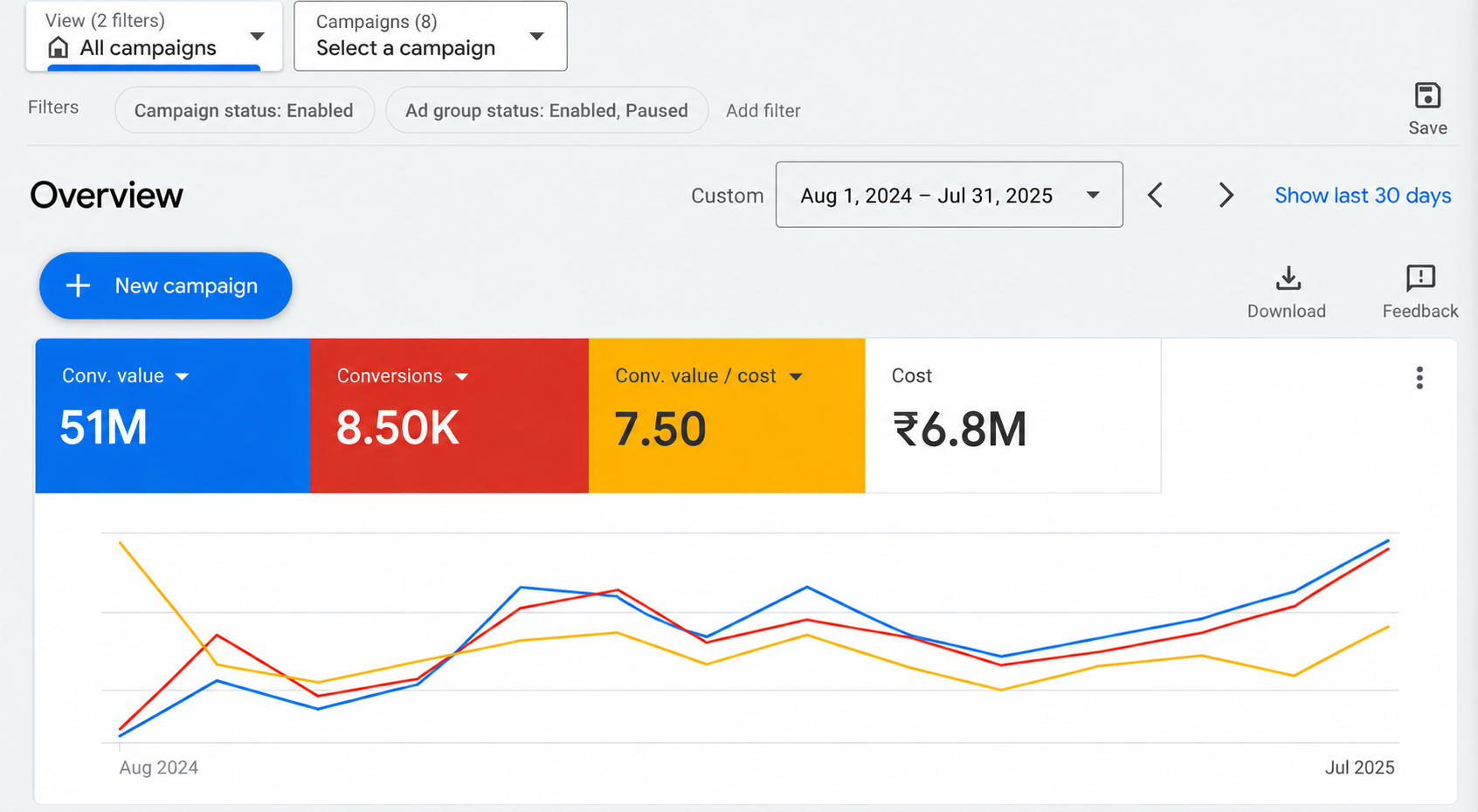
Over 365 days, the Google Ads campaigns generated ₹51 million in attributed conversion value with an advertising investment of ₹6.8 million. The campaign achieved a 7.50x return on ad spend, demonstrating the impact of structured campaign management, conversion-focused optimization, and continuous performance analysis.

₹51M
Total Revenue Generated

7.50x
Return on Ad Spend (ROAS)

8,500+
Total Conversions

₹6.8M
Total Advertising Investment
The Challenge: Scaling eCommerce Revenue Through Google Ads
Generating consistent online sales through paid advertising requires more than increasing campaign budgets.
The business needed a structured advertising strategy that could attract high-intent shoppers, improve conversion performance, and generate sustainable revenue.
The key challenges included:
- Attracting High-Intent Customers: Reaching potential customers who were actively searching for relevant products was essential. The challenge was to attract qualified traffic rather than spend advertising budgets on users with little purchase intent.
- High Advertising Costs & Budget Optimization: Managing advertising expenditure efficiently was a major priority. Budget allocation needed to focus on campaigns, products, and search queries delivering stronger conversion potential.
- Campaign Structure & Segmentation: Managing multiple products and customer search behaviours required a more organized campaign structure. Better segmentation across Google Search, Shopping, and Performance Max was necessary to improve campaign control and performance visibility.
- Improving Conversion Rates: Generating clicks and website traffic was not enough. The business needed to convert more visitors into paying customers through better targeting, relevant ad messaging, and an improved landing page experience.
- Product-Level Performance Optimization: Not every product generated the same advertising returns. Identifying high-performing products, reducing inefficient product spend, and prioritizing revenue-generating opportunities were essential for better budget utilization.
- Scaling Revenue While Maintaining ROAS: Increasing advertising spend without compromising campaign efficiency was one of the biggest challenges. The objective was to scale revenue strategically while maintaining a healthy return on advertising investment.
The Objective: Build a scalable, data-driven Google Ads strategy that could increase eCommerce sales, improve advertising efficiency, and generate measurable revenue growth over 365 days.
The Strategy: A Data-Driven Google Ads Growth Approach
Rather than treating Google Ads as a traffic-generation channel, the strategy focused on improving the entire customer acquisition process.
The following activities formed the core of the campaign optimization approach.

Google Ads Account Audit & Campaign Restructuring
Reviewed the advertising account to identify opportunities across campaign structure, targeting, budget allocation, and conversion performance. Restructured campaigns to improve performance visibility and create better control over advertising expenditure.

High-Intent Keyword Research & Targeting
Focused on transactional and commercial-intent search queries to attract users with stronger purchase intent. Refined keyword targeting and negative keyword lists to reduce irrelevant traffic and improve campaign relevance.

Google Shopping & Performance Max Optimization
Focused on product feed quality, product titles, descriptions, categorization, and campaign segmentation. Evaluated product-level performance to identify stronger revenue-generating opportunities and improve advertising efficiency.

Search Campaign Optimization
Optimized Search campaigns through keyword refinement, search term analysis, responsive search ad improvements, and landing page relevance. The objective was to connect relevant searches with the right products and landing pages.

Conversion Tracking & Revenue Measurement
Focused on tracking meaningful business outcomes, including purchases, conversion value, acquisition costs, and return on ad spend. Accurate measurement helped evaluate campaign performance beyond clicks and impressions.

Continuous Campaign Optimization & Budget Management
Regularly evaluated campaign performance to identify opportunities for improvement. Optimization focused on budget allocation, product performance, search terms, audience insights, and conversion trends.
Performance Report: 365 Days of Google Ads
The following performance figures summarize the campaign results from August 2024 to July 2025.
| Performance Metric | Campaign Results |
|---|---|
| Campaign Duration | 365 Days |
| Total Revenue | ₹51,000,000 |
| Total Advertising Cost | ₹6,800,000 |
| Return on Ad Spend (ROAS) | 7.50x |
| Total Conversions | 8,500 |
| Average Cost Per Conversion | ₹800 |
Key Insights & Opportunities for Further Growth
Achieving strong advertising returns is only one part of a successful performance marketing strategy.
There are additional opportunities to improve campaign efficiency and support future growth.
1. Improve Product-Level Performance
Identifying high-performing and underperforming products can help businesses make more informed budget allocation decisions.
2. Increase Conversion Rates
Landing page improvements, faster website performance, better product information, and a simplified checkout experience can create additional conversion opportunities.
3. Expand Remarketing Campaigns
Reaching relevant website visitors who have not completed a purchase can help recover potential lost sales.
4. Focus on Customer Lifetime Value
Understanding repeat purchase behaviour can help businesses identify valuable customer segments and make smarter acquisition decisions.
5. Optimize for Actual Business Profitability
ROAS should be evaluated alongside product margins, shipping expenses, discounts, returns, and other operational costs.
Client Feedback

Looking for Similar Growth for Your Business Website?
Let’s review your website, understand your goals, and identify practical SEO opportunities for your business.
